
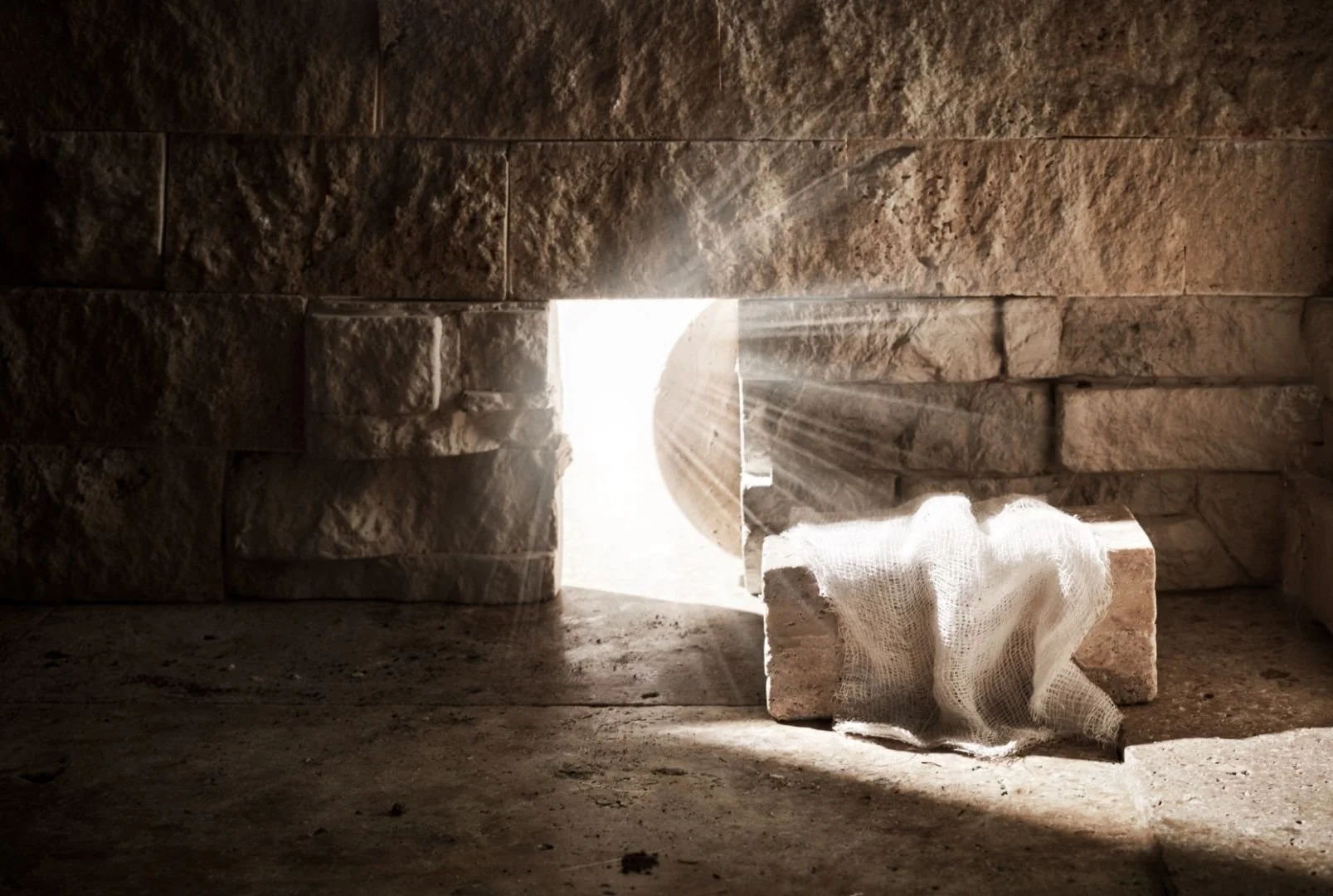
Theme: Our faith is built upon the risen Christ.
Text: 1 Corinthians 15:1-34
Here’s a thought: Billy Graham discovered, “There is more evidence that Jesus rose from the dead than there is that Julius Caesar ever lived or that Alexander the Great died at the age of thirty-three.”
Abraham Cressy Morrison, an accomplished chemist and former chairman of the New York Academy of Sciences, wrote an article entitled “Seven Reasons Why I Believe in God.” He said, “Consider the rotation of the earth. Our globe spins on its axis at the rate of one thousand miles an hour. If it were just a hundred miles an hour, our days and nights would be ten times as long. The vegetation would freeze in the long night or it would burn in the long day; and there could be no life.”
He said, “Consider the heat of the sun. Twelve thousand degrees at surface temperature, and we’re just far enough away to be blessed by that terrific heat. If the sun gave off half its radiation, we would freeze to death. If it gave off one-half more, we would all be crispy critters.”
He said, “Consider the slant of the earth – 23 degrees. If it were different than that, the vapours from the oceans would ice over the continents. There could be no life.”
He said, “Consider the moon. If the moon were fifty thousand miles away rather than its present distance, twice each day giant tides would inundate every bit of land mass on this earth.”
He said, “Think of the crust of the earth. Just a little bit thicker and there could be no life because there would be no oxygen. Or the thinness of the atmosphere was just a little thinner, the millions of meteors now burning themselves out in space would plummet this earth into oblivion. These are reasons why I believe in God.”
Several years before the Hubble telescope, Dr. George Schweitzer of the University of Tennessee said that with telescopes we could see one-sextillion miles. That’s one followed by twenty-one zeros. He said the distance across our galaxy is five hundred quadrillion miles. That’s five followed by seventeen zeros. He said the number of stars in our galaxy is over a million; and the number of galaxies is over a million; and the number of stars that at that time they had identified was over one hundred sextillion stars. That’s one followed by twenty-three zeros.
I don’t understand numbers like that. When I hear those figures, I’m like the fellow who saw an atomic explosion and said, “Wow, that atom bomb is dynamite.”
Professor Morrison, an expert in this field, stated that the mathematical probability of any two of those one hundred sextillion stars ever colliding is so remote that it can’t even be figured with present-day mathematical tools.
To say that a finely tuned, mathematically created universe just happened is about as credible as saying Webster’s Unabridged Dictionary was accidentally published because of an explosion in a printing factory or that a Boeing 747 was assembled when a tornado swept through a junk yard.
This same God who created our universe with such precision became flesh and dwelt among us. The One who became flesh and dwelt among us stirred a wide variety of responses – some loved Him dearly, and others hated Him intensely. The hatred was so intense that they crucified Him on a cross. Incredibly, God used this hatred to fulfill His plans so you and I could have a relationship with Him. He intervened again in the natural order of life and death, this time with…
The Reality of Christ’s Resurrection (1 Corinthians 15:1-8)
There is plenty of historical and archaeological evidence for Jesus Christ's life, death, and resurrection. When we stood at The Garden Tomb in Jerusalem in March 2012, I tried to comprehend the reality of Christ’s resurrection.
A singing group called “The Resurrection” was scheduled to sing for a church. When a big snowstorm postponed the performance, the pastor fixed the outside sign to read, “Resurrection is postponed.”
The Apostle Paul summarizes the Good News of Jesus Christ in 1 Corinthians 15:1-8:
1 Now, brothers, I want to remind you of the gospel I preached to you, which you received and on which you have taken your stand. 2 By this gospel you are saved, if you hold firmly to the word I preached to you. Otherwise, you have believed in vain. 3 For what I received I passed on to you as of first importance: that Christ died for our sins according to the Scriptures, 4 that he was buried, that he was raised on the third day according to the Scriptures, 5 and that he appeared to Peter, and then to the Twelve. 6 After that, he appeared to more than five hundred of the brothers at the same time, most of whom are still living, though some have fallen asleep. 7 Then he appeared to James, then to all the apostles, 8 and last of all he appeared to me also, as to one abnormally born. NIV
The Bible’s and our country’s legal systems are based on the premise that a conviction of a crime rests upon having sufficient evidence. Without credible witnesses, an accusation or a claim is not accepted as a fact. The Apostle Paul had played a key role in establishing the church in Corinth a few years earlier, but since teachers were denying the resurrection of Christ, it was time to revisit the facts.
If two or three credible witnesses agree on the critical facts of a crime, a judge or jury is almost certain to believe them. More than 500 witnesses could testify to the reality of Christ’s resurrection!
A rugged, practical fisherman named John explains the reasons for the radical change in his life in 1 John 1:1-3:
1 That which was from the beginning, which we have heard, which we have seen with our eyes, which we have looked at and our hands have touched - this we proclaim concerning the Word of life. 2 The life appeared; we have seen it and testify to it, and we proclaim to you the eternal life, which was with the Father and has appeared to us. 3 We proclaim to you what we have seen and heard, so that you also may have fellowship with us. And our fellowship is with the Father and with his Son, Jesus Christ. NIV
The Apostle Paul notes in his letter to the Corinthian church that some people were denying the reality of Christ’s resurrection. This is the conclusion that my friend, Colin, reached many years ago. He believed that when we die, our existence simply comes to an end, and there is no life in the hereafter. I had made many efforts to share Christ with him. He had, in fact, prayed to receive Christ at a Billy Graham Crusade in Calgary. I remember Colin telling me of his conclusion in our high school hallway. His choices at that time in his life certainly reflected his theology. Since he did not believe in the resurrection, he did his own thing without having to give an account to God.
I have since found that skeptics generally disbelieve the reality of Christ’s resurrection, not because of sound, logical arguments that they have considered. They usually do not want to face the uncomfortable reality of a Supreme Being to whom they will answer.
Billy Graham discovered, “There is more evidence that Jesus rose from the dead than there is that Julius Caesar ever lived or that Alexander the Great died at the age of thirty-three.”
How would you have responded to the empty tomb 2,000 years ago?
How do you respond to the empty tomb today?
The Results of Christ’s Resurrection (1 Corinthians 15:14-34)
When we stood inside the Garden Tomb, I tried to grasp the results of Christ’s resurrection.
One Easter Sunday morning, a pastor stood at the church door, speaking to the people as they left the service. A man who hadn’t been to a church service in a long time came by.
“Good morning, Frank,” the minister said. “I do wish we could see you here more regularly.”
“What do you mean regularly?” the man bristled. “I come every Easter!”
The resurrection of Jesus Christ has profound implications for our faith and for how we live each day. The Apostle Paul writes in 1 Corinthians 15:14-34:
14 And if Christ has not been raised, our preaching is useless and so is your faith. 15 More than that, we are then found to be false witnesses about God, for we have testified about God that he raised Christ from the dead. But he did not raise him if in fact the dead are not raised. 16 For if the dead are not raised, then Christ has not been raised either. 17 And if Christ has not been raised, your faith is futile; you are still in your sins. 18 Then those also who have fallen asleep in Christ are lost. 19 If only for this life we have hope in Christ, we are to be pitied more than all men. 20 But Christ has indeed been raised from the dead, the firstfruits of those who have fallen asleep. 21 For since death came through a man, the resurrection of the dead comes also through a man. 22 For as in Adam all die, so in Christ all will be made alive. 23 But each in his own turn: Christ, the firstfruits; then, when he comes, those who belong to him. 24 Then the end will come, when he hands over the kingdom to God the Father after he has destroyed all dominion, authority and power. 25 For he must reign until he has put all his enemies under his feet. 26 The last enemy to be destroyed is death. 27 For he “has put everything under his feet.” Now when it says that “everything” has been put under him, it is clear that this does not include God himself, who put everything under Christ. 28 When he has done this, then the Son himself will be made subject to him who put everything under him, so that God may be all in all. 29 Now if there is no resurrection, what will those do who are baptized for the dead? If the dead are not raised at all, why are people baptized for them? 30 And as for us, why do we endanger ourselves every hour? 31 I die every day - I mean that, brothers - just as surely as I glory over you in Christ Jesus our Lord. 32 If I fought wild beasts in Ephesus for merely human reasons, what have I gained? If the dead are not raised, “Let us eat and drink, for tomorrow we die.” 33 Do not be misled: “Bad company corrupts good character.” 34 Come back to your senses as you ought, and stop sinning; for there are some who are ignorant of God - I say this to your shame. NIV
1 Corinthians 15:29 is one of the most challenging verses in the Bible: “Now if there is no resurrection, what will those do who are baptized for the dead? If the dead are not raised at all, why are people baptized for them?”
Between 30 and 40 explanations have been given for this verse, but “The Teacher’s Commentary” provides the most straightforward interpretation that I have read. In this aside, Paul noted the practice of some in Corinth of being “baptized for the dead.” The simple meaning of the words seems to suggest that some at Corinth were undergoing baptism on behalf of friends who died without that sacrament. In referring to the practice, Paul did not endorse it. In fact, he disassociated himself from it by referring to “those” people, and saying “they” rather than “we.” Other than these words of Paul, the earliest written records of this practice come from the second century, but it was dismissed as a heretical, false practice by the early church fathers. The Church of Jesus Christ of Latter-day Saints (the Mormon Church) practices baptism for the dead today.
It’s clear that in the cases mentioned in this paragraph, Paul was reasoning from experience rather than from revelation. Why bother, he said, to undergo such a baptism if your friends are simply dead and gone, and there is no resurrection? Why should the missionary team with Paul keep on endangering their lives if death is really the end? If this life is all, why not live by that modern saying in verse 32, “Eat and drink, for tomorrow we die”?
No, it is the prospect of the final transformation that leads the Corinthians to this strange practice and Paul’s commitment to his mission. Paul’s point was simply this: wandering from the truth about resurrection will have an impact on daily life. What the Corinthians and Paul have been doing makes sense only if there is a resurrection coming. Once this conviction is abandoned, both practices and commitments, which reflect the belief, are sure to change.
The paragraph raises an essential question for you and me. What do we do because we also believe in resurrection? How would our lives be different if we abandoned this hope?
Take a step back and consider:
The Reality of Christ’s Resurrection
The Results of Christ’s Resurrection
Our faith is built upon the risen Christ.